How to get your brand recommended by ChatGPT: the 2026 guide
ChatGPT recommends the brands that other sources already recommend. Here's how to check what it says about you, make sure it can read your site, get named in the places it reads, and measure the result every month.
 By Etienne Rozenblad · Founder & CEO, Tjenno AIFacts checked on 10 October 2026 · 11 sources
On this page
- How ChatGPT decides which brands to name
- Step 1: Find out what ChatGPT says about you now
- Step 2: Make sure ChatGPT can read your site
- Step 3: Say what you are, the same way everywhere
- Step 4: Get named in the sources ChatGPT reads
- Step 5: Measure it in four layers
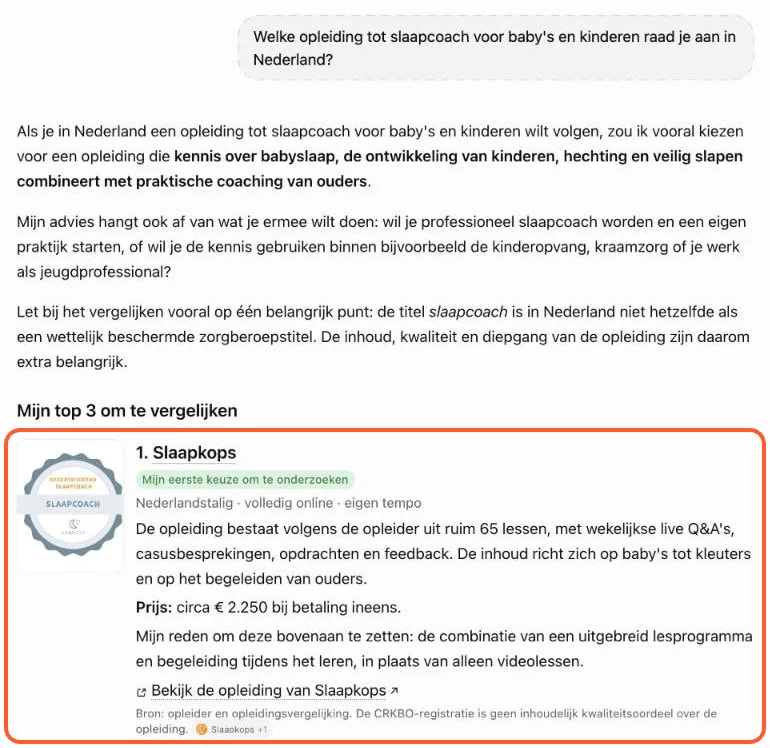
- Example: how Slaapkops became a source in AI answers
- Can you pay to be recommended?
- A 30-day plan
- FAQ
The short answer
When someone asks ChatGPT for the best option in your category, it often searches the web, reads a handful of pages and sums up the names that keep coming up. So you don't rank in ChatGPT by tweaking one page. You get recommended when three things are true:
- ChatGPT can crawl and understand your site.
- You describe what you do the same way everywhere.
- The pages it reads, such as reviews, comparison articles and forums, already mention you.
Then you measure it with the same 15 questions every month, so you know whether it's working.
How ChatGPT decides which brands to name
ChatGPT answers in two ways. For general questions it answers from what it learned during training. For questions that benefit from current information, such as "best project management tool for a 10-person agency" or "a good Shopify agency in Amsterdam", it searches the web first. OpenAI says ChatGPT may search automatically when a question would benefit from current information, and that it sometimes works with partner search providers, rewriting your question before sending it on.
The search route is the one you can influence most. In practice it works like this:
- ChatGPT turns the question into one or more search queries.
- It reads a small set of results: comparison articles, review sites, forums, brand websites and news.
- It writes an answer from what those pages agree on, and shows the pages it used as sources.
- The question
What's the best project management tool for a 10-person agency?
- Search
ChatGPT turns it into one or more search queries and searches the web.
- Read
It reads a handful of pages. In this example, 5 of the 8 mention your competitor.
- ComparisonCompetitor
- ReviewCompetitor
- ForumOthers
- Top 10 listCompetitor
- NewsCompetitor
- ComparisonOthers
- ForumCompetitor
- Brand siteOthers
- Answer
It names the brands that come up most often and shows the pages as sources.
RecommendedYour competitorin 5 of 8 sourcesYouNot mentionedin 0 of 8 sources
That last step explains most of what you see. For example, if five of the eight pages ChatGPT reads mention your competitor and none mention you, your competitor gets recommended. Large-scale data points the same way. In a study of 75,000 brands, Ahrefs found that mentions of a brand across the web correlated strongly with how visible it is in ChatGPT, AI Mode and AI Overviews (0.66 to 0.71), far more than domain rating (0.27 to 0.33). Mentions on YouTube correlated most of all, at about 0.74. Correlation isn't proof, but it matches what we see in client work.
And the training route? What the web said about you before a model's training cut-off shapes what ChatGPT "knows" without searching. The levers are the same: be described clearly and mentioned widely. It just takes longer to show.
Step 1: Find out what ChatGPT says about you now
Before you change anything, measure. We use a fixed set of 15 questions, written the way your buyers actually ask them.
| Type | Questions | Example |
|---|---|---|
| Category | 5 | Best [category] for [type of customer] in [country] |
| Problem | 4 | How do I [problem your product solves]? |
| Comparison | 3 | Alternatives to [competitor], or [you] vs [competitor] |
| Brand | 3 | What is [brand]? Is [brand] any good? |
How to run them:
- Use a temporary chat set to Unpersonalized, so your memory and custom instructions don't colour the answer.
- Ask each question in ChatGPT and, if your buyers use them, in Gemini, Perplexity and Google's AI Overviews or AI Mode.
- For every answer, note whether you're named, in which position, which competitors are named and which sources are cited.
- Keep the wording identical every month. Answers vary from one run to the next, so judge the trend across all 15 questions, not a single answer.
The result is a simple score, for example "named in 2 of 15 answers", plus a list of the sources that keep getting cited in your category. That list is your to-do list for step 4.
Step 2: Make sure ChatGPT can read your site
ChatGPT can't cite a page it can't fetch. Four checks:
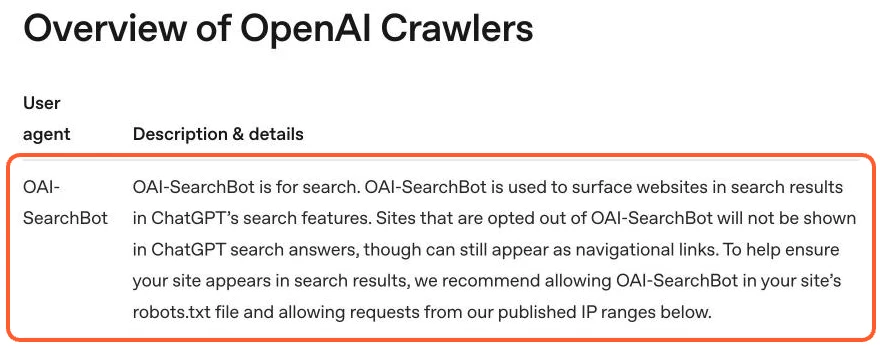
- Allow OAI-SearchBot in robots.txt. This is the crawler OpenAI uses for search, and OpenAI is explicit: sites that opt out of OAI-SearchBot won't be shown in ChatGPT search answers. GPTBot is a different crawler, used for training. Blocking GPTBot keeps your content out of training, not out of search. Each setting is independent, and changes can take about 24 hours to reach search.
- Check your CDN and security tools. OpenAI also asks that your host or CDN lets through traffic from its published search bot IP addresses. Firewalls and bot protection sometimes block AI crawlers by default, so check those settings, not just robots.txt.
- Get your site into Bing. ChatGPT works with partner search providers, and OpenAI's help pages point to Microsoft as one of them. Verify your site in Bing Webmaster Tools and submit your sitemap.
- Keep key text in the HTML. Put what matters in the page itself, not only in scripts, tabs that load later or images. If you can't see it with JavaScript switched off, assume a crawler may miss it too.
What about llms.txt? It's a proposed file that summarises your site for AI tools. It's cheap to add, but there's little evidence the big assistants use it to decide whom to recommend. It's not where we'd start.
Step 3: Say what you are, the same way everywhere
ChatGPT can only recommend you for a category if the web agrees on which category you're in. Write one plain sentence and use it everywhere:
[Brand] is a [category] for [customer] in [market], known for [proof].
For example, for a made-up webshop: "Lumelo is a Dutch webshop for solar garden lights, known for its five-year warranty." Then:
- Put it on your homepage, your about page and in the first lines of your main category page.
- Use the same wording on the profiles that describe you: Google Business Profile, LinkedIn, the review platforms in your market, marketplaces and directories.
- Add Organization schema with
sameAslinks to those profiles, so machines can connect them to you. - Build pages that answer buying questions directly: who it's for, what it costs, how you compare with alternatives and what customers say. Answer in the first lines and back it with specifics such as prices, numbers, places and dates. Specific facts get quoted; vague claims don't.
Step 4: Get named in the sources ChatGPT reads
This is where most of the work is, and where most brands stop too early. Go back to the sources you collected in step 1 and group them:
| Source type | What to do |
|---|---|
| "Best of" and comparison articles | Ask the author to review you and offer something useful: data, a demo or a customer to talk to. Articles that are clearly out of date are the easiest to get updated. |
| Review platforms | Ask happy customers for reviews on the platforms that get cited in your category, not just the one you happen to use. |
| Forums and Reddit | Answer genuinely, as yourself, where your category is discussed. No fake accounts, no drive-by links. |
| YouTube | Reviews, demos and how-to videos, your own and other people's. In the Ahrefs data, YouTube mentions had the strongest correlation of any factor. |
| Industry media and partners | Original data, a useful tool or a clear opinion gets you quoted. Partner and supplier pages that list you count too. |
Two rules. First, go where the citations already are, not where it's easiest to publish. Second, never fake it: invented reviews and undisclosed paid placements break platform rules and consumer law, and they aren't worth the risk.
Step 5: Measure it in four layers
One number won't tell you whether this works. We measure four layers, from the earliest signal to the business result.
- Answers
The 15 questions, every month: how often you're named, next to whom, and which sources are cited.
Spreadsheet or a tracking tool - Google
Search Console's generative AI reports, available to all sites since 31 August 2026, show how often your pages appear in AI Overviews and AI Mode. Impressions only, no clicks.
Google Search Console - Bing and Copilot
The AI Performance report, launched in public preview in February 2026, shows how often Copilot and Bing's AI answers cite your pages, and the grounding queries behind those citations.
Bing Webmaster Tools - Visits and leads
A channel for AI assistants in GA4: visits from chatgpt.com, perplexity.ai, gemini.google.com and copilot.microsoft.com, and the leads or sales they bring.
Google Analytics 4
Layer 1 moves first and layer 4 last. ChatGPT adds utm_source=chatgpt.com to the links it sends visitors through, which helps in GA4, but expect that layer to stay small for a while: many people read the answer and never click. If layer 1 hasn't moved after three months, go back to step 4.
Example: how Slaapkops became a source in AI answers
Slaapkops is a Dutch practice for child sleep coaching, and one of our clients. Its articles answer a parent's question in the first lines, and they keep two audiences apart: parents looking for help, and future coaches looking for the training. And never any medical advice.
Source: Google Search Console for slaapkops.nl, read 25 September 2026.
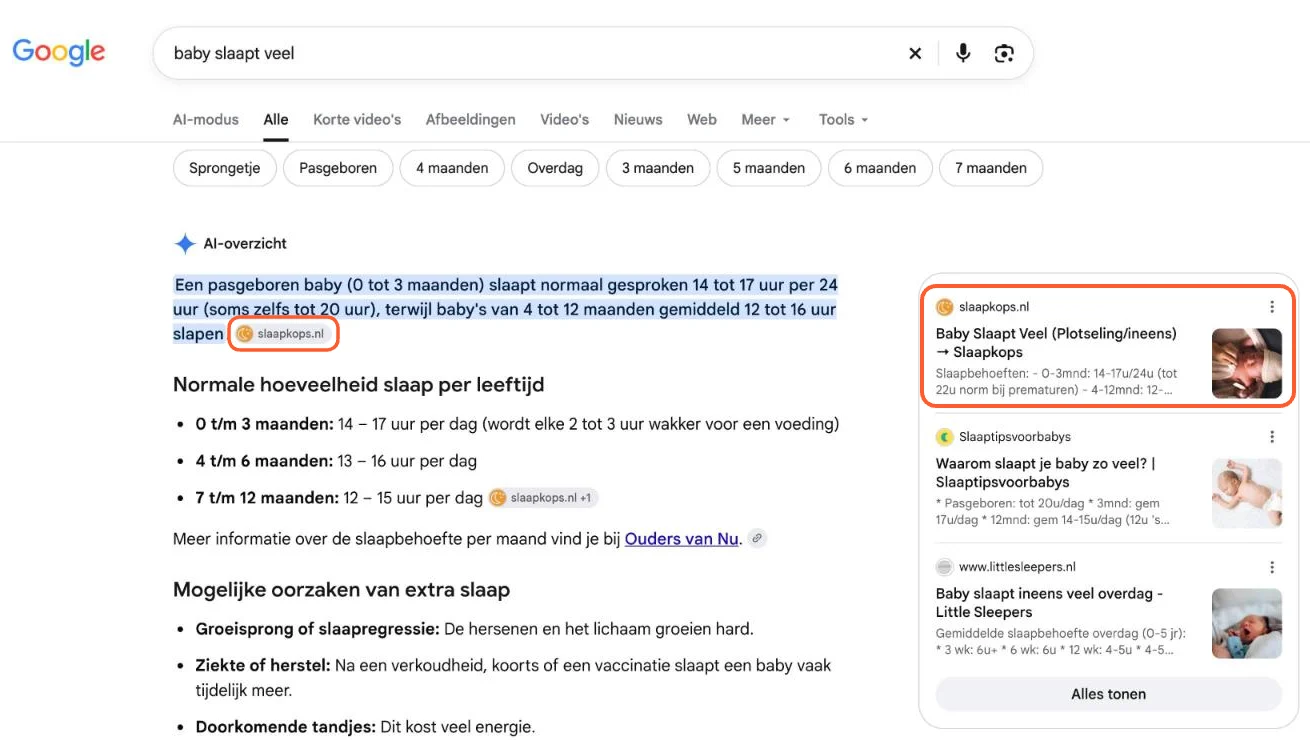
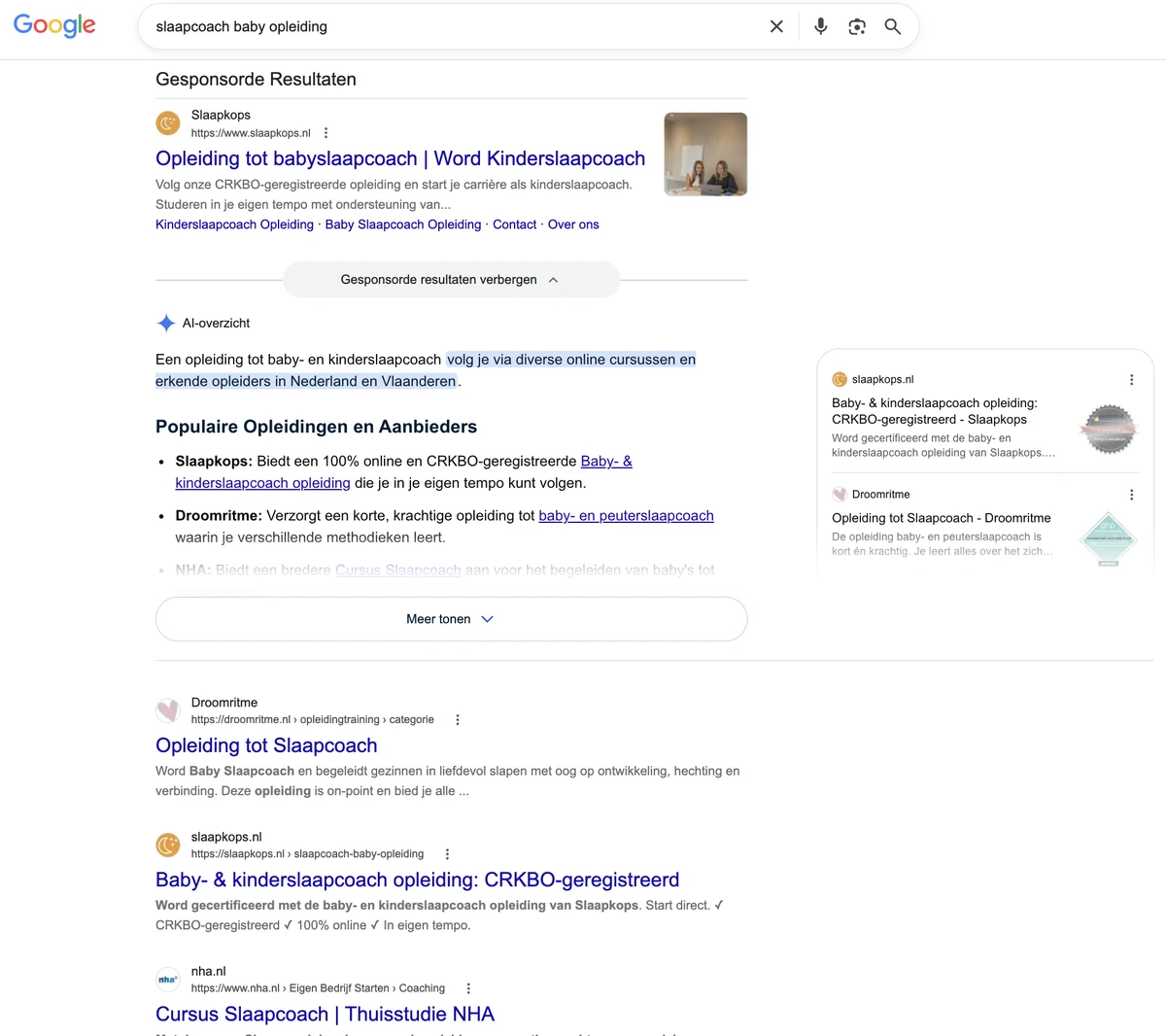
These numbers come from Google's AI features, because that's where Search Console can measure them. The approach is the one in this guide: answer the question in the first lines, be specific, and be the page that other answers are built on. Read the Slaapkops case.
Can you pay to be recommended?
Not in the answer. Since late August 2026, advertisers in 31 European countries, the Netherlands included, can buy ads in ChatGPT. But OpenAI's ad principles state that ads do not influence the answers ChatGPT gives, and that ads are clearly labelled and kept apart from the answer. They're shown on the Free and Go plans, not on Plus, Pro, Business or Enterprise.
So ads can buy you a place next to the answer, not in it. For the right offer they're worth a test, and we're writing up our field notes from a live account in a separate article.
A 30-day plan
- Week 1Baseline
Write your 15 questions, run them and record mentions and sources. Check robots.txt, your CDN settings and Bing Webmaster Tools.
- Week 2Clarity
Write your one-sentence description and update your homepage, about page and the five profiles that get cited most. Add Organization schema.
- Week 3Answers
Improve or build the three pages buyers need most: your category page, a comparison page and a pricing page. Answer in the first lines.
- Week 4Sources
Contact five of the sources ChatGPT cites in your category, each with something worth mentioning.
- Every monthMeasure
Rerun the 15 questions and check the four layers. Adjust step 4 to what moves.
Sources
- OpenAI, Overview of OpenAI Crawlers, consulted 10 October 2026
- OpenAI Help Center, ChatGPT search, consulted 10 October 2026
- OpenAI Help Center, Temporary Chat FAQ, consulted 10 October 2026
- OpenAI, Our approach to advertising and expanding access to ChatGPT, 16 January 2026
- OpenAI, ChatGPT Ads expands across Europe, 18 August 2026, updated 31 August 2026
- OpenAI Help Center, Publishers and developers FAQ, consulted 10 October 2026
- Google Search Central, Introducing Search Generative AI performance reports in Search Console, June 2026
- Search Engine Roundtable, Search Console generative AI reports released to all sites, 1 September 2026
- Bing Webmaster Blog, Introducing AI Performance in Bing Webmaster Tools Public Preview, 10 February 2026
- Ahrefs, Top Brand Visibility Factors in ChatGPT, AI Mode, and AI Overviews (75k Brands Studied), 12 December 2025
- Slaapkops: Google Search Console for slaapkops.nl, read 25 September 2026
Facts checked on 10 October 2026.
Etienne runs SEO and GEO for clients such as Slaapkops and Wrap je Keuken, and tests every tactic on Tjenno AI's own sites first. Former agency owner with a bachelor's in Commercial Economics.
Meet the team →How long does it take to show up in ChatGPT?
Crawling changes are quick: OpenAI says robots.txt changes can take about 24 hours to reach search. Being named more often takes longer, because it depends on other sites mentioning you. In our experience the first movement in a 15-question score shows after two to three months.
Can I pay ChatGPT to recommend my brand?
No. Ads in ChatGPT are labelled and shown apart from the answer, and OpenAI states that ads do not influence the answers ChatGPT gives.
Does blocking GPTBot remove my site from ChatGPT?
No. GPTBot is OpenAI's crawler for training. ChatGPT search uses OAI-SearchBot. Block GPTBot and allow OAI-SearchBot if you want to stay out of training but still appear in ChatGPT search.
Is this different from SEO?
It builds on SEO: crawlable pages, clear content and authority still matter. The goal differs. SEO aims for a position in a list of links; GEO, generative engine optimisation, aims to be named in the answer, which depends more on what other sources say about you.
Do I need an llms.txt file?
It doesn't hurt, but it isn't a priority. There's little evidence the big assistants use it to decide whom to recommend. Start with crawling, a clear description and the sources ChatGPT reads.